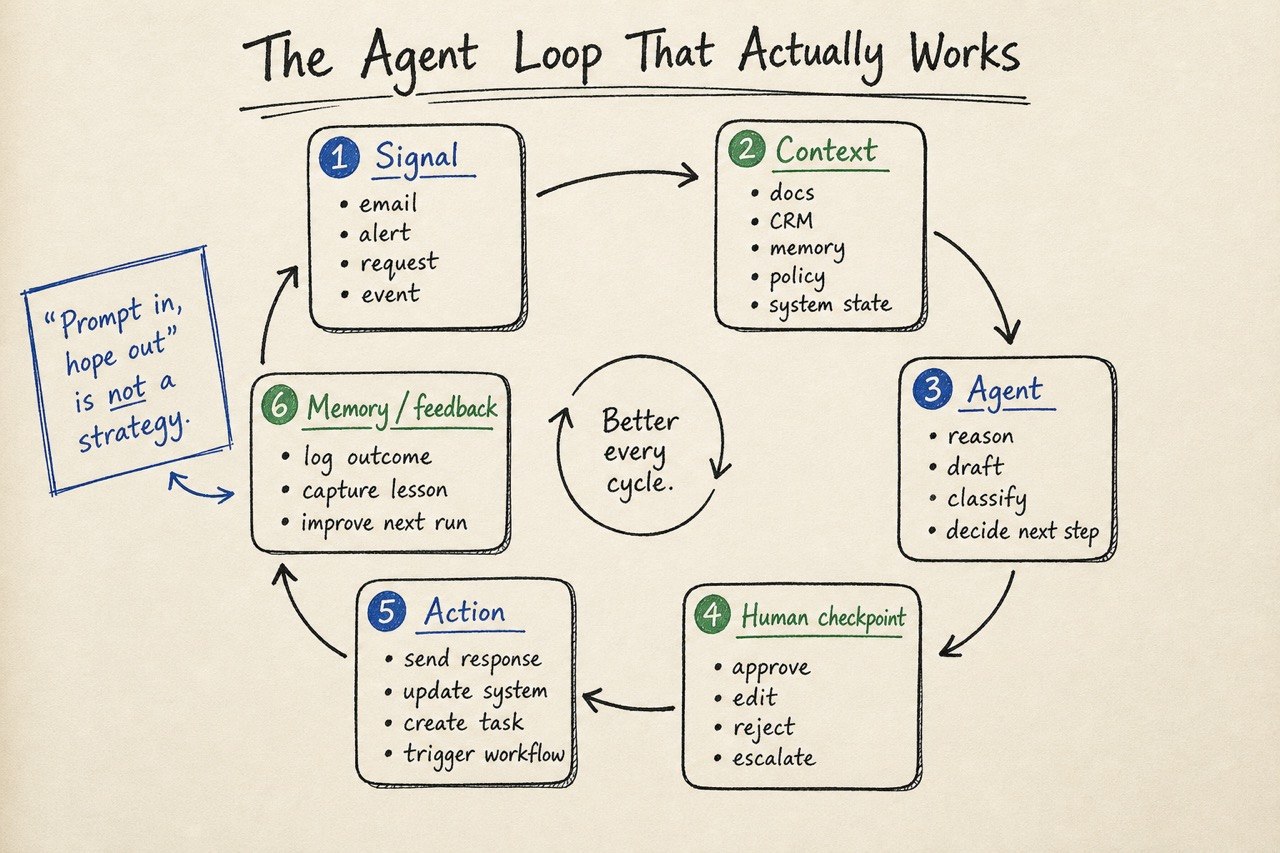
Most companies do not need another AI tool.
They need one agent loop that actually works.
That sounds almost too simple, but it cuts straight through a lot of the noise in enterprise AI right now. Too much of the conversation is still centered on model capability, prompt tricks, demo flows, and product screenshots that look impressive right up until the moment they have to interact with real systems, real policies, real customers, or real operational constraints.
That is where things usually fall apart.
Because the real problem is not whether the model can produce something clever. The real problem is whether the surrounding system is designed well enough for that intelligence to be useful, safe, and repeatable.
A lot of so-called agent systems are still built around a surprisingly weak idea:
Prompt in, hope out.
That is not a system. It is a demo with better branding.
The teams getting real value from AI are usually doing something less flashy and much more important. They are building loops. Real loops. Loops with triggers, context, bounded tasks, checkpoints, actions, and feedback. Loops that do not assume the model is always right, but also do not reduce it to a toy.
That is the difference between interesting output and dependable capability.
The real unit of value is not the model
A lot of AI strategy still sounds like procurement with extra excitement.
Which model should we use? Which copilot should we buy? Which agent framework is winning? Which assistant can connect to which system?
Those are not useless questions, but they are secondary ones.
The real unit of value is not the model on its own. It is the loop the model operates inside.
If the signal is noisy, the system starts with bad work. If the context is weak, the model confidently improvises. If the task is not bounded, the behavior becomes unpredictable. If there is no human checkpoint where judgment matters, avoidable mistakes escape. If the agent cannot take action in a real system, the output is just expensive text. If nothing gets written back, the same mistakes repeat forever.
That is why so many AI experiments look promising in isolation and disappointing in production. The intelligence is not enough. The loop is broken.
What the loop actually needs
A working agent loop is not magic. It is just more structured than the current hype cycle likes to admit.
At a minimum, it needs six things:
- Signal
- Context
- Agent
- Human checkpoint
- Action
- Memory / feedback
None of these are optional if the goal is reliability rather than theater.
1. Signal
Every useful loop starts with a real signal.
That might be:
- an incoming customer email
- an operational alert
- a new request
- a system event
- a failed workflow
- a document that needs review
This matters because not every input deserves intelligent processing. If the signal quality is poor, the rest of the loop is wasted on noise.
One of the most common design mistakes is starting from the model instead of starting from the event that should trigger work. When that happens, companies end up with AI looking for problems to solve instead of handling work that actually matters.
Good signal design is boring, but important. It decides what enters the system, when it enters, and why.
2. Context
Once the loop is triggered, the next requirement is context.
Not generic world knowledge. Not a giant unfiltered data lake. Actual working context.
That usually includes things like:
- relevant documentation
- CRM records
- policy rules
- account history
- current system state
- prior outcomes
- operational constraints
This is where a lot of “smart” systems become unreliable. The model often has enough language ability to sound convincing, even when it is missing the information required to make a good decision. That creates one of the most dangerous patterns in AI adoption: confident output built on partial context.
If context is weak, everything downstream becomes fragile.
A good agent loop does not just pass more data into the prompt and hope for the best. It makes deliberate choices about what context is relevant, trusted, current, and allowed.
That last part matters too. Not every piece of available information should be visible to every agent. Context design is not just about usefulness. It is also about boundaries.
3. Agent
Then comes the model itself, which is where too many discussions begin and end.
This is the part that can:
- reason across inputs
- classify requests
- draft responses
- summarize findings
- decide a next step
- identify ambiguity
- propose an action
All of that is useful. None of it is sufficient.
The agent should not be treated like an unbounded genius sitting in the middle of your operating model. It should be treated like a capable component inside a controlled system.
That means the task needs to be bounded. What is the agent trying to do? What decisions is it allowed to make? What tools can it call? What states can it move something into? What level of confidence is good enough? When should it stop and ask for help?
These are architecture questions, not prompt questions.
A lot of the slop in enterprise AI comes from skipping this discipline and replacing it with optimism.
4. Human checkpoint
This is where many teams get weirdly ideological.
Either they want full autonomy immediately, which is usually reckless, or they insert human review everywhere, which kills the point of automation.
The real answer is more practical. Put human checkpoints where judgment, risk, or exception handling actually matter.
A human checkpoint can:
- approve
- edit
- reject
- escalate
That is enough.
The goal is not to prove that humans are still important. The goal is to place review exactly where it improves the system without dragging everything back into manual work.
In some loops, the checkpoint should happen early. In others, only when the agent crosses a risk threshold. In mature systems, some loops may not need one at all for low-stakes tasks.
But removing human checkpoints entirely before you understand the failure modes is usually just overconfidence in nicer packaging.
5. Action
This is where value either materializes or evaporates.
If the output of the agent never leaves the chat window, you do not have much of a system. You have generated text.
Action is what turns intelligence into operational effect.
That might mean:
- sending a response
- updating a CRM record
- creating a ticket
- triggering a workflow
- changing a status
- generating a task for a team
- logging a case into another platform
This step forces clarity. It asks the uncomfortable question many AI projects avoid: what exactly should happen in the world if this loop works?
If the answer is vague, the system is vague.
And once an agent is taking action, the surrounding controls matter even more. Permissions, approval chains, write-back logic, auditability, and rollback paths stop being “nice to have” and become part of the core design.
6. Memory / feedback
This is the part that separates a repeating demo from an improving system.
If the outcome of the loop is not captured, nothing gets better. If exceptions are not logged, the same edge cases return. If edits and approvals do not teach the next cycle anything, the organization just keeps paying humans to correct identical mistakes.
Memory does not need to be mystical. It just needs to be useful.
A good loop should capture things like:
- outcome
- correction
- escalation reason
- exception type
- follow-up action
- what worked
- what failed
That creates the basis for improvement.
Without this, every cycle starts from almost the same place. With it, the system can slowly become more reliable, more efficient, and more selective about where human attention is actually needed.
That is when you begin to get compound returns.
Why architecture matters again
This is the part I find most interesting.
For a while, a lot of enterprise technology discussion tried to minimize architecture. Move fast, wire things together, buy a platform, let product teams experiment, avoid big design up front. Some of that pushback was fair. Plenty of architecture work deserved the criticism.
But agent systems are making one thing very clear again:
If the loop matters, architecture matters.
Not architecture as slideware. Not architecture as governance theater. Architecture as the discipline that decides whether an intelligent system can be trusted.
That includes:
- trust boundaries
- context access
- policy enforcement
- tool permissions
- state management
- checkpoint placement
- write-back rules
- observability
- recovery design
- failure handling
These are not side concerns. They are the system.
The hard part is not getting a model to say something smart. The hard part is building a loop that can survive contact with reality.
That is where most of the leverage is. It is also where most of the risk is.
What good looks like
A good agent loop usually does not look dramatic.
It looks bounded. It looks understandable. It looks operationally boring in the best sense.
It has:
- a clear trigger
- the right context
- a defined task
- a sensible approval model
- real action
- logged outcomes
- measurable improvement over time
It does not try to automate everything on day one. It does not confuse autonomy with quality. It does not pretend exceptions are edge cases if they happen every Tuesday.
Most importantly, it earns trust by being reliable, not by sounding futuristic.
That is the benchmark that matters.
Final thought
I do not think AI will reward the companies with the most pilots, the most prompts, or the most internal demos.
It will reward the ones that design the cleanest loops.
Because once the novelty wears off, that is what remains:
- signal
- context
- action
- control
- feedback
- iteration
That is where useful systems come from.
And that is what an agent loop that actually works looks like.