Most people still think AI means one of three things:
- a chatbot on a website
- a better autocomplete
- a fancier way to generate text, images, or support replies
That frame is already outdated.
The real shift is not “AI that answers.” It is AI that acts.
And almost no one — especially executives, consultants, and customer-experience teams — seems to understand how big that difference is.
We are moving from software that waits for instructions to systems that can pursue goals across tools, files, APIs, and decisions. That changes everything. Not just marketing. Not just support. Everything.

The misunderstanding
Most companies still treat AI like a feature.
They ask:
- Can it write emails?
- Can it summarize calls?
- Can it answer FAQs?
- Can it reduce support tickets?
That thinking is way too small.
Agentic AI is not just about producing an output. It is about:
- interpreting intent
- choosing actions
- navigating systems
- handling exceptions
- continuing until the job is done
That means the disruption will not come from “better content generation.” It will come from workflows collapsing.
The companies still thinking in terms of “assistants” are underestimating what happens when software stops being a passive tool and starts behaving more like a junior operator.
The real interface shift: a personal assistant that can use your machine
This is the part people miss.
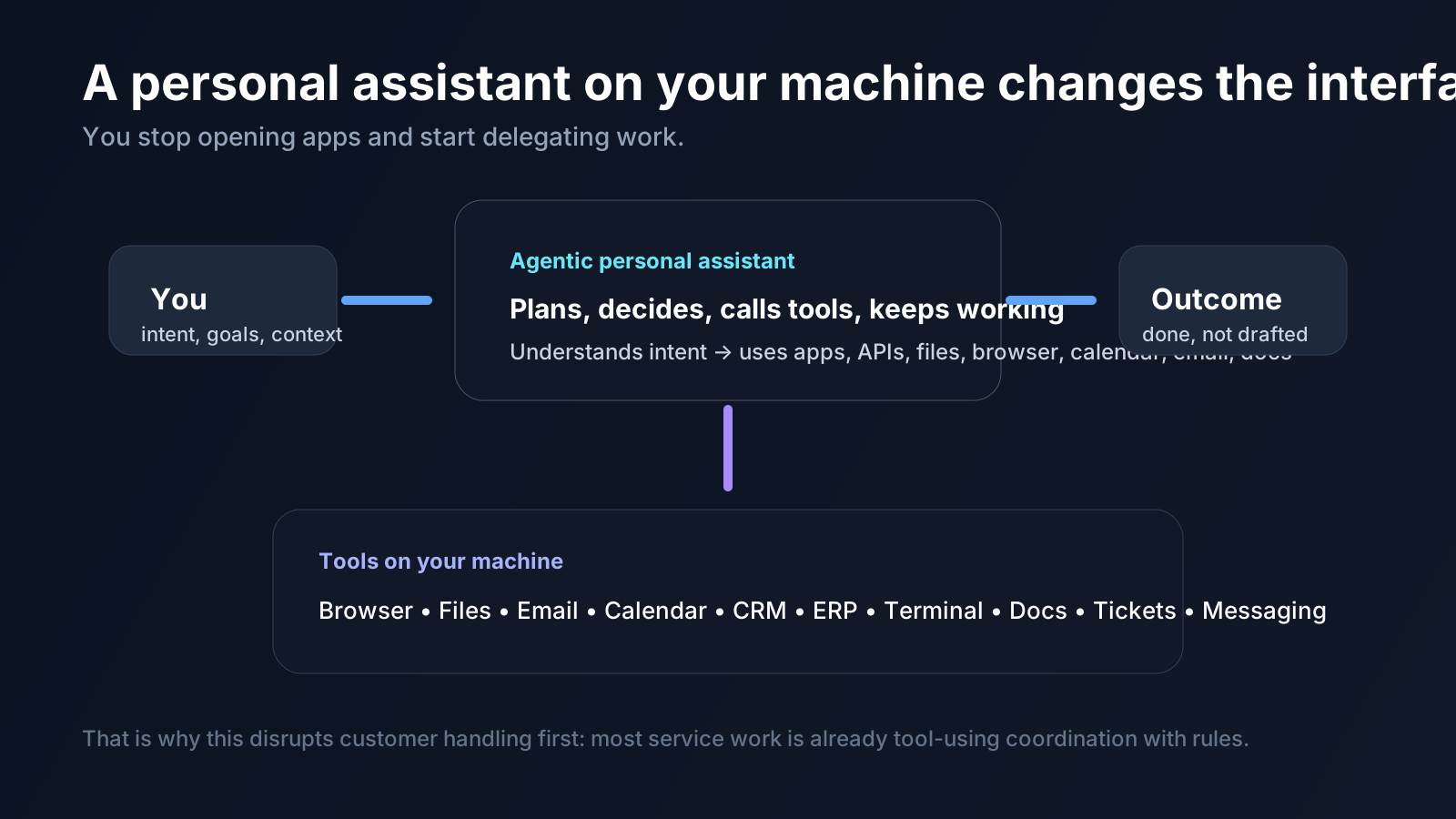
The useful version of agentic AI is not just a web chatbot with a nicer personality. It is a personal assistant that can do things on your machine for you.
That means it can potentially:
- open the browser and find the right page
- read and update files
- send messages
- draft and reply to emails
- check your calendar
- move through internal tools
- trigger APIs
- inspect logs
- update a CRM
- summarize what happened
- continue the task until it is actually finished
That is a different class of software.
The user experience changes from:
“Let me open six apps and move this forward manually.”
To:
“Handle this for me. Let me know if you get stuck.”
That is not just convenience. That is a new operating model.
What changes in customer handling
Customer service is one of the first places where this becomes obvious.
Right now, most companies run some ugly mix of:
- forms
- queues
- email chains
- ticketing systems
- escalation layers
- internal handoffs
- copy-pasted macros
- partial CRM context
- and tired humans trying to stitch together an answer
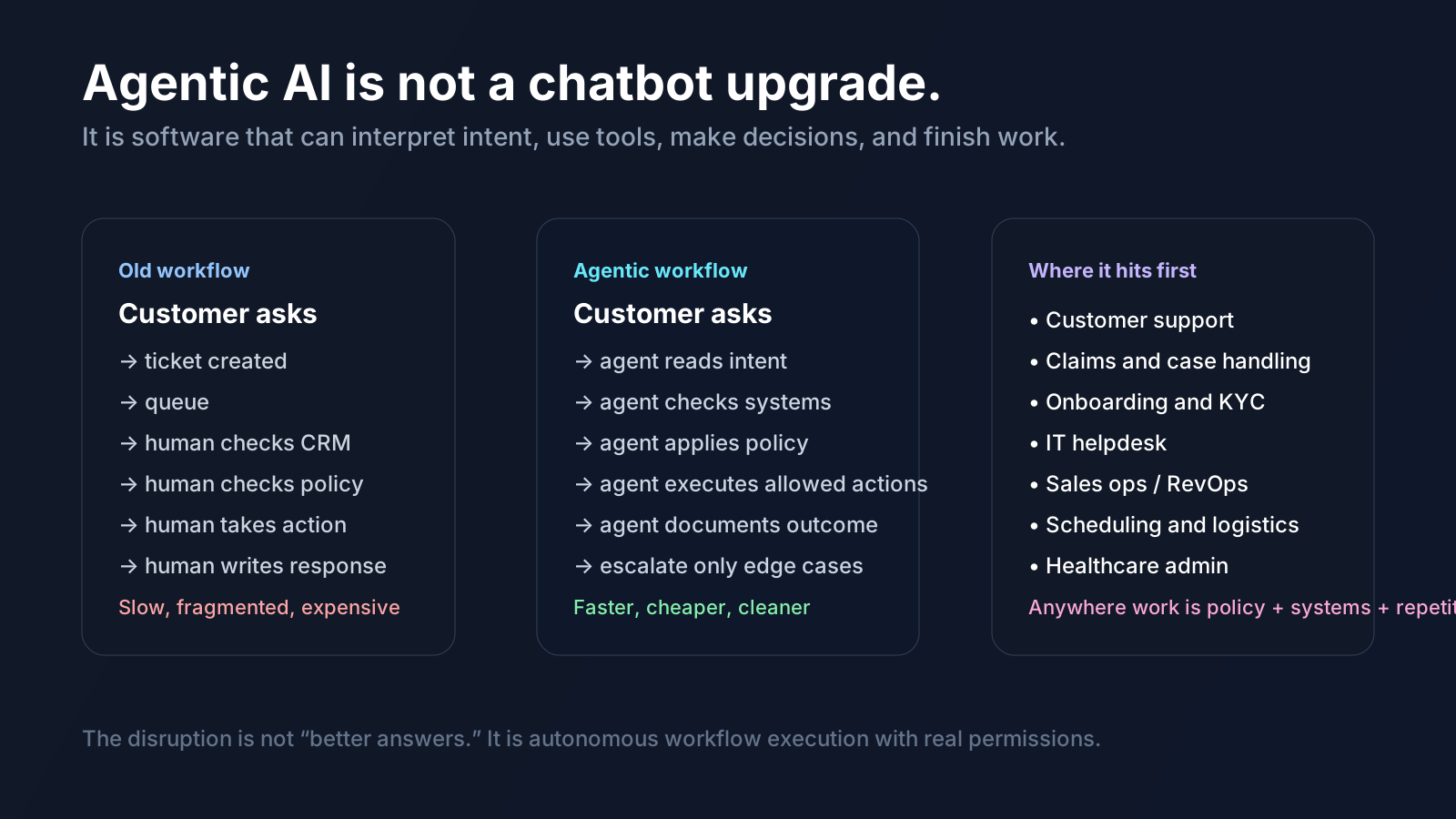
Agentic AI can cut straight through that mess.
Instead of:
- collecting a request
- assigning it
- waiting for a human
- checking three systems
- sending a response
- doing follow-up
- and maybe creating a task for another team
…an agent can often:
- understand the issue
- authenticate context
- look up the customer
- inspect order, subscription, or account state
- take the allowed actions
- document what happened
- escalate only when needed
That is not a “faster chatbot.” It is a partial replacement of the service operation itself.
And once that works well enough, the old org chart starts looking shaky.
This is bigger than support
Customer handling is just the obvious wedge.
The same pattern applies to:
- sales ops
- onboarding
- claims processing
- compliance workflows
- finance admin
- scheduling
- procurement
- recruiting coordination
- IT helpdesk
- account management
- customer success
- internal reporting
- service dispatch
- healthcare admin
- legal intake
- property management
- logistics exception handling
Anywhere work currently looks like this:
- receive request
- inspect context
- check systems
- apply policy
- take action
- update records
- communicate result
…agentic AI is coming for it.
Not because humans are useless. Because a shocking amount of white-collar work is structured coordination disguised as complexity.
Why people are still underestimating it
1. They are anchored to chat UX
They see a prompt box and assume the product is “conversation.”
Wrong frame.
Conversation is just the interface. The real story is decisioning plus execution.
2. They focus on model intelligence, not system design
People obsess over benchmarks, reasoning scores, and whether one model is 8% better than another.
That matters. But it is not the main thing.
The real unlock comes from combining:
- model capability
- tool access
- memory
- permissions
- workflow logic
- domain constraints
- fallback handling
That stack is what makes agents commercially dangerous.
3. They think disruption starts at 100% reliability
It does not.
It starts when the economics beat the current process.
If a human team handles 100 cases with 95% quality at a high cost, and an agent handles 80 of them well with fast escalation on the hard edge cases, the business case shows up much earlier than people expect.
That is how disruption usually works:
- not perfect replacement
- just a better cost and throughput curve
The orgs that are most exposed
The most exposed companies are not necessarily the least technical ones.
It is the ones built on administrative drag.
If your company depends on lots of people:
- moving information between systems
- translating customer intent into internal tasks
- triaging exceptions
- chasing follow-ups
- manually enforcing routine policies
…you are exposed.
That includes huge parts of:
- insurance
- banking
- telecom
- ecommerce
- SaaS
- travel
- healthcare administration
- public sector services
- utilities
- real estate operations
Many of these industries still confuse complexity with defensibility.
But a lot of that “complexity” is just bad process held together by labor.
Agentic AI sees that as an opportunity.
What customer expectations will look like
This is the part most leadership teams have not internalized.
Once customers get used to agentic systems, they will stop tolerating broken workflows.
They will expect:
- answers immediately
- actions immediately
- fewer handoffs
- less repetition
- less waiting
- fewer portals
- less “we have forwarded your request”
- less “someone will get back to you”
They will not care whether the work was done by:
- a human
- an agent
- or a hybrid workflow
They will care that it got done.
And once one company in a category gets this right, everyone else starts looking slow, bureaucratic, and incompetent.
The internal political problem
A lot of companies will delay this transition for one reason: internal politics.
Agentic AI does not just threaten budgets. It threatens managerial structure.
If a workflow that currently needs:
- frontline staff
- team leads
- QA
- queue managers
- ops analysts
- internal coordinators
…can be compressed into:
- one human exception team
- one agent platform
- one policy layer
- one systems owner
then a lot of middle layers start looking optional.
People feel that before they say it out loud.
So what happens?
Organizations hide behind:
- governance
- trust
- brand safety
- human touch
- “we are still exploring”
Some of that is legitimate. A lot of it is just institutional self-defense.
What smart companies should actually do
The right move is not “replace support with a chatbot.”
That is dumb and shallow.
The right move is:
- map real workflows
- identify repeatable decision and action loops
- define permissions carefully
- set confidence thresholds
- let agents own the easy-to-medium path
- build clean escalation for edge cases
- measure outcomes, not just response speed
Start where there is:
- clear policy
- structured systems
- repetitive intent
- expensive human coordination
- measurable resolution outcomes
That is where the returns show up first.
The next five years
The next wave of winners will not just be companies that “use AI.”
It will be companies that redesign themselves around the fact that software can now:
- reason well enough
- operate tools
- remember context
- complete multi-step tasks
- and manage a meaningful share of customer and operational workflows
That will change:
- staffing models
- service design
- SLAs
- customer expectations
- software categories
- competitive moats
A lot of software vendors are in trouble too.
If the product mainly exists to route, track, or coordinate routine knowledge work, agentic systems may eat a lot of that value.
Final point
Most people are still debating whether AI can “help employees.”
That is yesterday’s question.
The real question is this:
What happens when a large percentage of customer handling and operational work no longer needs to be handled the old way at all?
That is where the disruption is.
And the people who still think this is about chatbots are going to get run over by those who understand that it is really about autonomous workflow execution at scale.