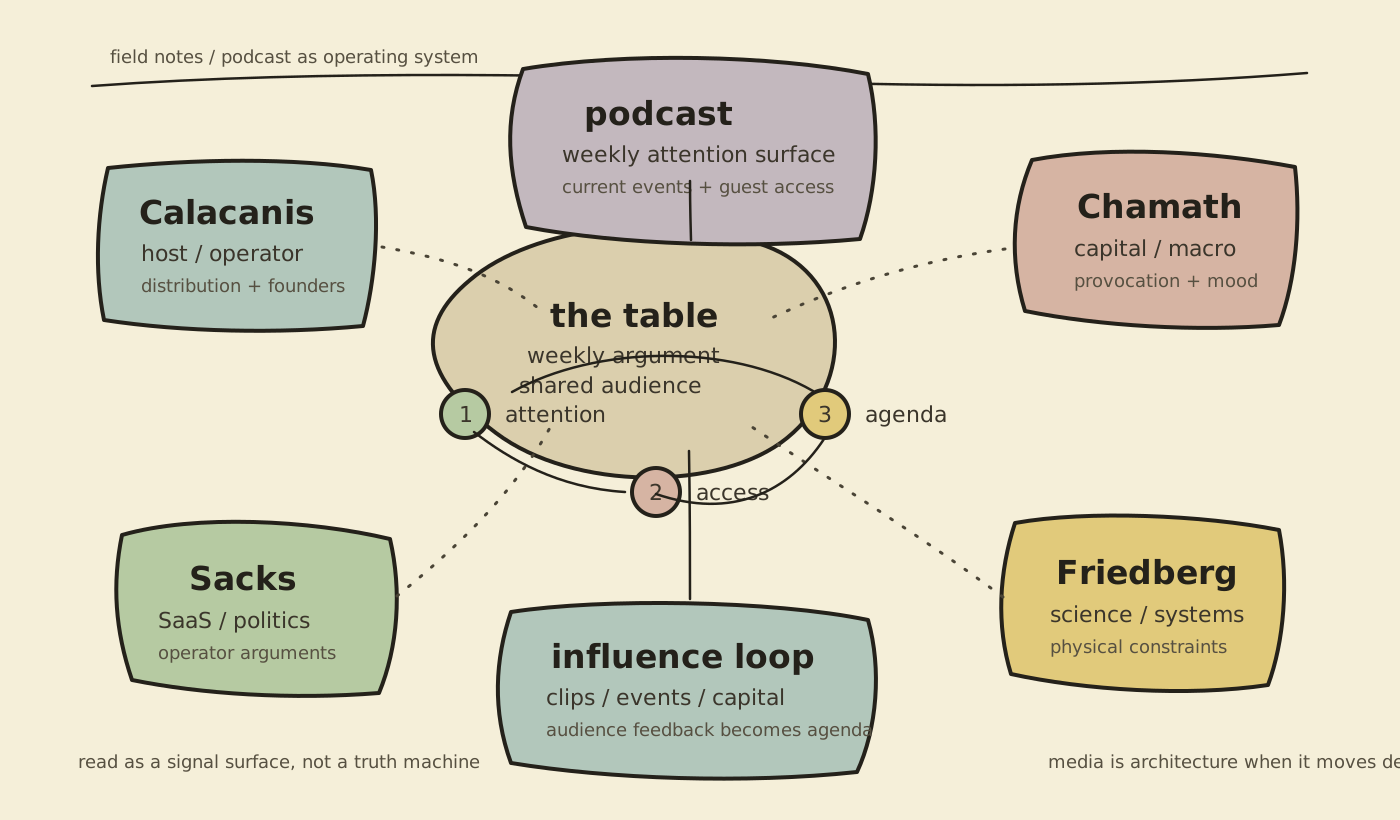
I have been thinking about All-In less as a podcast and more as a system.
On the surface it is simple: four Silicon Valley friends talk about markets, startups, politics, AI, science, and whatever else moved the timeline that week.
That is the visible product.
The more interesting thing is the machine around it.
All-In is a weekly media format, a clip factory, a founder access layer, an events business, a capital network, a political signal surface, and a running argument between four different kinds of technology operator.
That combination is why it matters.
Not because every take is right. Plenty are not. Not because the format is neutral. It is not. All-In is loaded with incentives, relationships, investment positions, political preferences, and founder-world assumptions.
That is exactly why it is worth studying.
Modern influence rarely looks like an institution anymore. It looks like a feed, a podcast, a conference, a group chat, a fund, a few recurring characters, and an audience that knows the jokes.
All-In has all of those parts.
The table is the product
The official story is charming enough. The show began when the pandemic interrupted the hosts’ regular poker game, so they moved the conversation into a public format.
That origin matters because the show still feels like a table.
Not an interview desk.
Not a polished media panel.
A table.
Jason Calacanis plays the operator-host role. He keeps the format moving, understands distribution, and tends to drag the conversation back toward startups, founders, products, and the audience. He is also the executive producer, which is not a small detail. The person who shapes the room shapes the product.
Chamath Palihapitiya brings the capital allocator voice. His background is Facebook growth, Social Capital, public-market narratives, and big directional calls. He is often most useful when you treat him as a market mood detector rather than as a clean forecasting machine.
David Sacks brings the enterprise operator and political operator voice. PayPal, Yammer, Craft, SaaS, product-led growth, go-to-market discipline, and now a much more explicit role in the political conversation around technology.
David Friedberg is the systems thinker at the table. Climate Corporation, The Production Board, food, agriculture, life sciences, genetics, and a tendency to pull the conversation toward data, science, incentives, and physical constraints.
That is the chemistry.
Calacanis distributes.
Chamath reframes.
Sacks prosecutes.
Friedberg models.
Sometimes that creates a genuinely good conversation. Sometimes it becomes predictable. Sometimes the incentives are too visible. But the format works because each host carries a different part of the technology economy with him.
The media layer is only one layer
The mistake is to judge All-In as only audio.
The podcast is the weekly heartbeat, but the surrounding system does much more work.
There are short clips for social platforms. There are current-events segments that let the show attach itself to whatever everyone is already arguing about. There are interviews with founders, CEOs, investors, politicians, and public intellectuals. There are live events like All-In Summit and All-In Liquidity. There is a recognizable language around the “Besties.” There are repeated segments, callbacks, inside jokes, and status markers.
That makes the podcast a kind of operating surface.
The audience does not only consume the show. It learns how to read the hosts, which topics matter, who is in the network, what is investable, which narratives are rising, and which arguments are acceptable inside that corner of tech.
That is more powerful than a normal media property.
A normal media outlet can cover a market.
All-In can help create the mood inside one.
Access compounds
The guest list tells part of the story.
All-In has hosted or highlighted people like Elon Musk, Sam Altman, Brian Armstrong, Bill Gurley, Ray Dalio, Sheryl Sandberg, President Trump, RFK Jr., Rahm Emanuel, Dario Amodei, and many others.
That is not just content.
It is access turned into programming.
The show gives guests a route into an audience of founders, investors, operators, engineers, executives, and politically interested technologists. The guests give the show credibility and news value. The clips give everyone distribution. The events turn attention into rooms. The rooms turn attention back into relationships.
That loop is the product.
And it compounds.
When a podcast has enough distribution, it becomes easier to book better guests. Better guests produce better clips. Better clips attract a larger audience. A larger audience makes the event more valuable. The event strengthens the network. The network improves future access.
This is media as infrastructure.
The conflicts are part of the architecture
There is an uncomfortable part too.
The same structure that makes All-In useful also makes it messy.
The hosts are not detached journalists. They are investors, founders, operators, donors, advisors, and public political actors. They have positions. They have friends. They have companies and funds and reputations. The show can function as analysis, entertainment, lobbying, defense, marketing, recruiting, and narrative warfare, sometimes in the same episode.
That does not make it worthless.
It means you should not consume it like a truth machine.
I think the right way to read All-In is as a signal surface.
What are powerful people in tech choosing to talk about?
Which terms are being normalized?
Which companies are getting sympathetic treatment?
Which risks are framed as obvious, and which ones are waved away?
Which political positions are becoming comfortable inside founder culture?
Where does Friedberg slow the room down with actual systems thinking?
Where does Sacks move from operational analysis into political narrative?
Where does Chamath smell a macro shift before the rest of the room has language for it?
Where does Calacanis reveal what early-stage founders are excited or scared about?
Those are useful questions.
What enterprise architects can steal from it
This is the part I care about most.
All-In is a good reminder that distribution is architecture.
Inside companies, we often treat architecture as diagrams, principles, review boards, standards, and documentation. Those matter, but they rarely create energy on their own.
The missing layer is usually rhythm.
Who convenes the conversation every week?
Where do the interesting people show up?
Which problems get repeated until they become shared language?
Where are the good examples made visible?
What gets clipped, reused, and carried into other rooms?
Who has enough credibility to say, “this matters” before the organization already agrees?
All-In does that for a slice of Silicon Valley.
A good internal platform team should learn from the shape, not copy the politics.
If you want better API design, cloud patterns, agent governance, observability, or architecture discipline, the artifact alone is not enough. A template does not move culture. A Confluence page does not create taste. A standard does not become real just because it was approved.
You need a recurring forum, a shared vocabulary, visible examples, opinionated owners, guest voices, feedback loops, and a way for good ideas to travel.
That is the boring enterprise version of the same pattern.
Podcast becomes architecture review.
Clips become internal write-ups.
Summit becomes platform day.
Guests become teams showing real work.
Audience feedback becomes backlog.
Capital allocation becomes engineering priority.
The medium changes, but the system logic is familiar.
The lesson is not to become All-In
Most companies do not need their own tech bro podcast.
Please do not start one because you read this.
The useful lesson is smaller and more practical.
All-In works because it bundles attention, access, identity, conflict, and repetition into one recognizable format.
That is also how serious internal change spreads.
If you are trying to make agents safer, make APIs cleaner, modernize integration architecture, or build a platform people actually use, you need more than a repository of rules.
You need a table.
You need people who own the conversation.
You need visible examples of the work.
You need a cadence.
You need enough taste and disagreement that the conversation does not become corporate wallpaper.
And you need to remember that every distribution system has incentives baked into it.
All-In is not just four people talking.
It is a case study in how modern technology influence is packaged, routed, amplified, and monetized.
That makes it useful.
It also means you should keep your eyes open while listening.