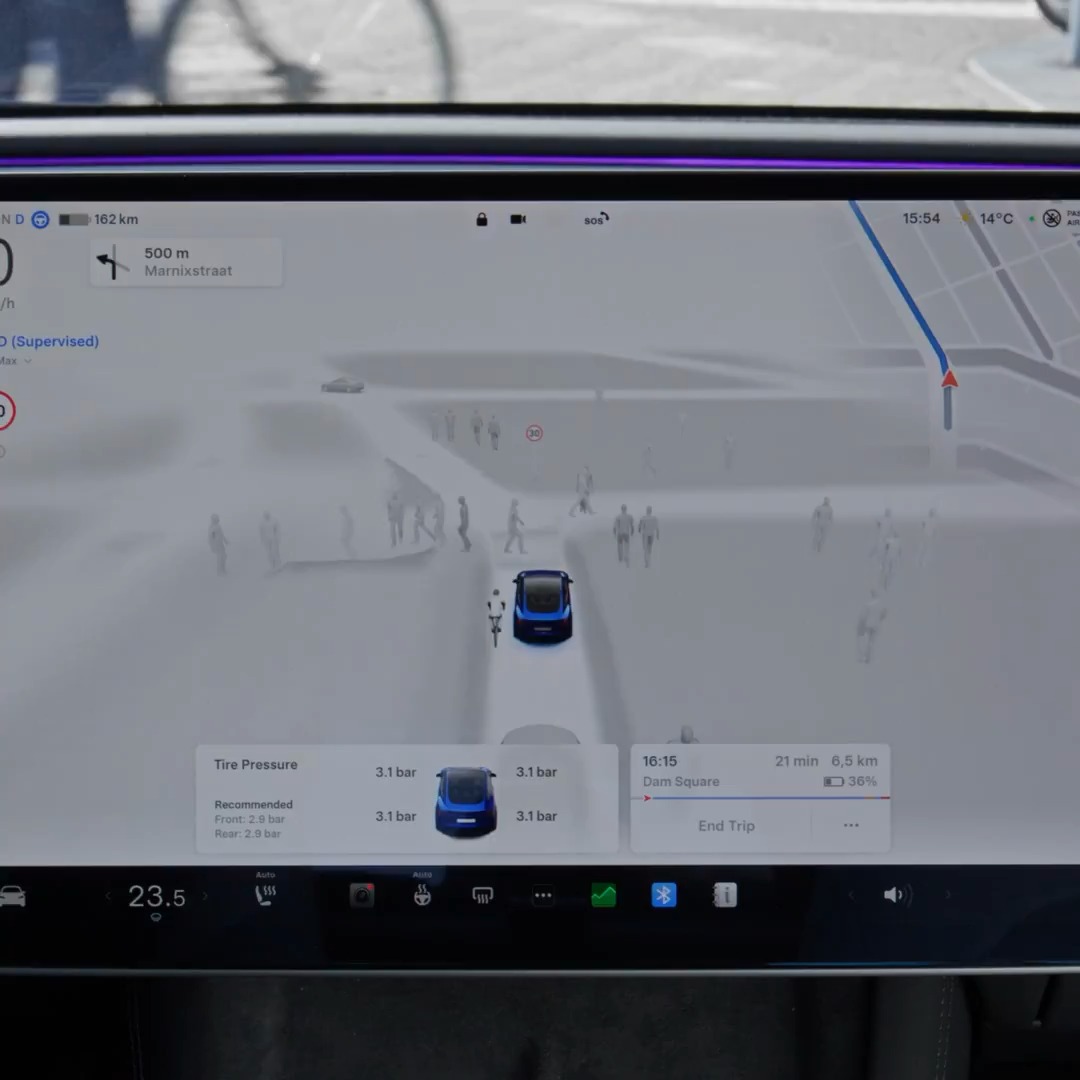
Tesla has finally cleared an actual European regulatory hurdle.
The Dutch vehicle authority, RDW, has issued type approval for FSD Supervised in the Netherlands. That matters for one simple reason: this is the first serious sign that Tesla’s most ambitious driver assistance system is moving into Europe through the real regulatory process, not just through speculation, leaks, or another round of Elon timing.
And if you live in Denmark, the obvious question is this:
Does this mean we’re next?
Not immediately. But it does make the Danish timeline a lot more real than it was a week ago.
First, what was actually approved?
Let’s be precise, because Tesla’s branding has made this topic messy for years.
RDW describes FSD Supervised as a driver-controlled assistance system, not a self-driving car. The driver remains responsible at all times and must stay attentive, with hands available to take over immediately if needed.
That distinction is not a footnote. It is the whole legal foundation.
“Full Self-Driving” sounds autonomous. What RDW approved is not autonomy. It is an advanced driver assistance system that can handle more of the driving task while keeping the human fully responsible.
According to RDW, the system was tested for more than one and a half years on both a test track and public roads. That is a long regulatory slog, not a casual sign-off.
Why the Netherlands matters
This is not just a Dutch one-off.
RDW says the approval is currently valid only in the Netherlands, but it also lays out the path toward wider EU use:
- RDW submits the application to the European Commission
- member states vote on it
- approval requires a majority in the responsible committee
If that vote passes, the system can become valid across the EU.
That is the real shift here.
The Netherlands is not the finish line. It is the first credible domino.
What this could mean for Denmark
Denmark is not guaranteed to get FSD Supervised tomorrow because the Netherlands got approval today. Anyone selling that take is doing fan fiction.
Still, this approval changes the Danish outlook in three meaningful ways.
1. The regulatory barrier is no longer theoretical
For years, European Tesla owners have heard the same vague story: Europe is stricter, regulators are slower, maybe next year.
Now there is an actual EU approval authority saying yes, at least nationally and at least under a supervised framework.
That does not complete the process, but it proves the process is moving.
2. Denmark is now more likely downstream from an EU vote than from a Tesla surprise launch
The most plausible path from here is not some Denmark-specific approval.
It is broader EU admission after the Commission process and member-state vote.
If that happens, Denmark would probably get access as part of that wider framework.
That means the Danish timeline is now tied less to Tesla hype and more to EU committee timing. Slower, yes. But also far more real.
3. Denmark looks like a reasonable rollout market once Europe opens up
Denmark is a small, EV-heavy, highly digitized market with generally structured roads and decent lane discipline. On paper, it is the kind of environment where a supervised driver assistance system should be easier to launch than in more chaotic markets.
That does not mean Tesla flips the switch on day one. Rollout could still be phased by geography, software confidence, validation scope, or internal caution.
But if EU-wide approval lands, Denmark does not look like an obvious edge case.
My read on the timeline
Here is the blunt version.
This is the strongest signal yet that Denmark could get FSD Supervised within a meaningful timeframe, but meaningful probably still means months, not days.
The key question is no longer whether Tesla can get any European authority to approve the system at all.
It just did.
The real uncertainty now is:
- how quickly RDW and the Commission move
- how fast member states vote
- whether any restrictions get attached
- how Tesla sequences country rollout after broader approval
If I had to frame it conservatively, I would say this:
The Dutch approval makes a Danish rollout plausible in the next EU decision cycle. It does not make it imminent.
That is still a major change from the old situation, where the timeline was basically rumor with a charging cable attached.
Europe will not get the US version one-to-one
RDW also made an important point that a lot of Tesla fans will skip past.
European and US approvals work differently, and the software versions are not directly comparable. RDW explicitly says the US and EU versions of FSD Supervised are not one-to-one equivalents.
So if you are in Denmark waiting for the exact American FSD experience, that is probably the wrong expectation.
Europe will almost certainly get a more constrained, more compliance-shaped version. That is not necessarily bad. It is just the reality of launching this kind of system in a stricter regulatory environment.
Why this matters even if you are skeptical of Tesla
You do not have to buy into Tesla’s mythology to see why this matters.
If Tesla can get a more capable supervised driving system through European approval, it puts pressure on the rest of the market. BMW, Ford and Mercedes have already been pushing parts of this category under specific conditions. Tesla entering the conversation more seriously raises the bar for what drivers will expect from advanced assistance systems across Europe.
That is good for competition.
It is also good for clarity. The debate can finally move away from “will Europe ever allow this?” and toward the more useful question: what kind of supervised automation should Europe allow, under what constraints, and how fast?
Bottom line
The Dutch approval is not the finish line.
But it is real. It is concrete. And for Danish Tesla owners, it is probably the first genuinely credible sign that FSD Supervised is moving from fantasy to timetable.
Not tomorrow.
Not guaranteed.
But no longer abstract.
That alone is a pretty big shift.
Tesla Europe rollout post